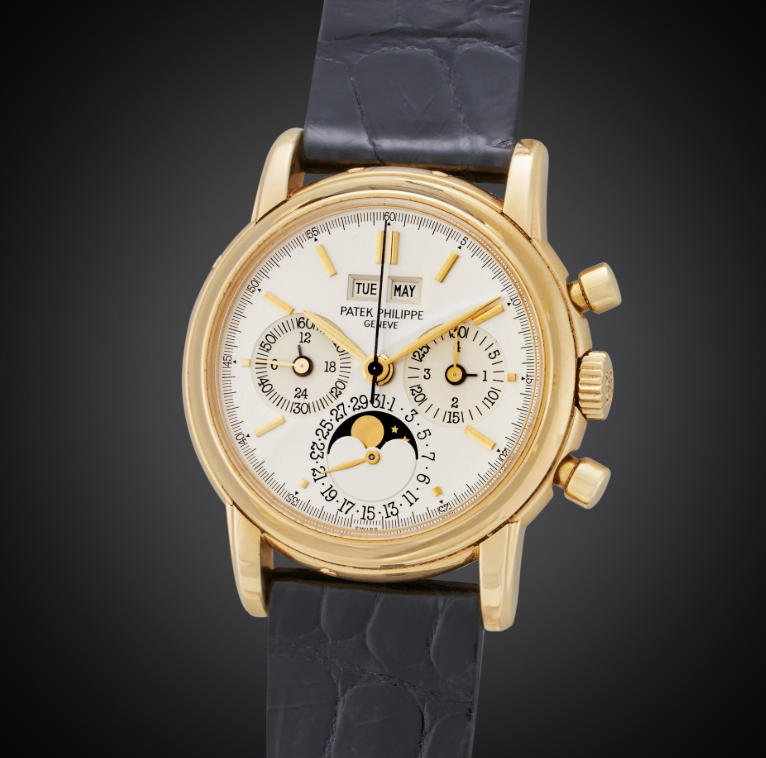

When an early Patek Philippe appears at auction, the details often matter more than the headline estimate. Case numbers, movement numbers, original components and the history of a particular reference can all change the way collectors look at a watch. Sotheby’s upcoming Geneva sale brings together several of these elements in one particularly interesting example: a yellow gold Patek Philippe Reference 3970J made in 1986, recognised as the first numbered example of the reference and known as The First 3970.
The importance of this watch goes back to a much longer story. Patek Philippe introduced the Reference 1518 in 1941, establishing the company’s tradition of serially produced perpetual calendar chronographs. The Reference 2499 followed in 1950 and remained an important part of the collection until the mid-1980s. When the 3970 arrived in 1986, it was not intended to abandon that established design. Instead, it brought the familiar combination of chronograph and perpetual calendar functions into a new generation of mechanical watchmaking.
For readers interested in independent watch research and design coverage from Watchestore UK, the 3970 is worth understanding beyond its auction value. It represents a period when traditional complications were being developed with more modern movement technology, while retaining the restrained proportions that had made earlier Patek Philippe chronographs so distinctive. The transition from the 2499 to the 3970 was evolutionary rather than radical, but some of the technical changes were significant.
The Reference 3970J offered by Sotheby’s has an 18-carat yellow gold case measuring 36.2mm. Its silvered dial is characteristic of the earliest production examples, with applied yellow gold rectangular hour markers and elegant feuille hands. The case is relatively compact by contemporary standards, yet the dial accommodates several functions without appearing excessively crowded. That balance is one of the reasons the reference has remained interesting to collectors long after its production ended.
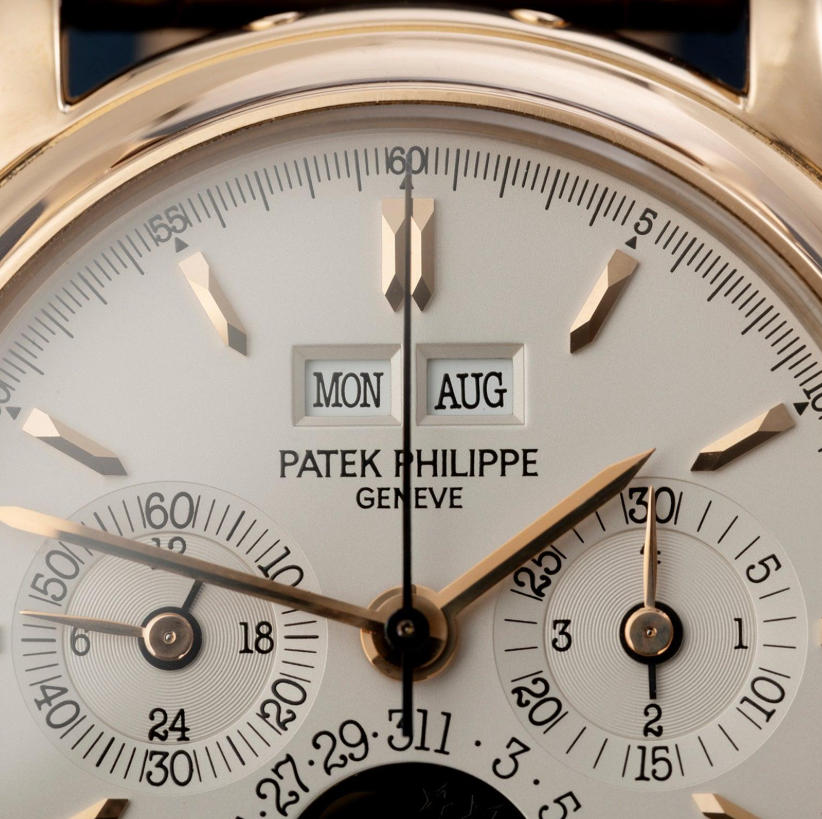
Look closely at the dial and the arrangement begins to make more sense. The day and month are displayed through two apertures below 12 o’clock. The subsidiary registers provide the chronograph indications, running seconds, leap year and 24-hour information, while the date and moon phase are positioned at 6 o’clock. The contrasting finishes of the subsidiary registers add depth to the silvered surface and make the different displays easier to distinguish.
This is what makes the Patek Philippe 3970 perpetual calendar chronograph such an important mechanical watch. A chronograph measures elapsed time, while a perpetual calendar accounts for the different lengths of the months and the leap year cycle. Bringing both functions together requires a considerably more complicated mechanism than a standard time-only movement. The moon phase adds another traditional indication, but it is the coordination of the calendar and chronograph functions that gives the watch its technical significance.
There is also an important difference between the first 3970 and the versions that followed. The earliest series used a solid snap-on caseback, whereas the second series introduced a screw-down caseback and the 3970E designation. The letter E comes from the French word étanche, referring to water resistance. The first series is generally dated to 1986 through 1988, with approximately 100 examples believed to have been produced. These early watches are particularly recognisable through their case construction, rectangular applied indexes and leaf-shaped hands.
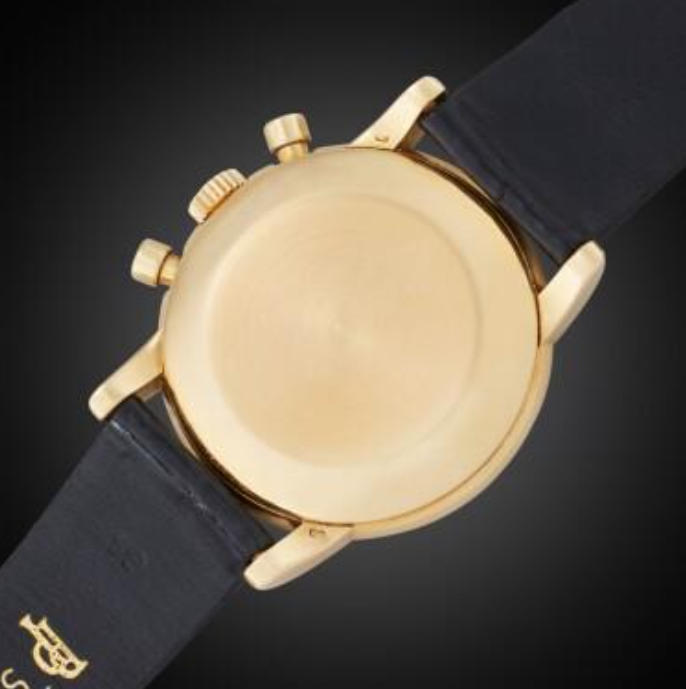
Later production brought further changes to the dial and case. Different generations used variations in hand shape, hour markers and caseback arrangements, while the collection eventually appeared in yellow gold, white gold, pink gold and platinum. This is why simply identifying a watch as a 3970 is not always enough for collectors. The production series and individual configuration provide a much clearer picture of where it belongs in the history of the reference.
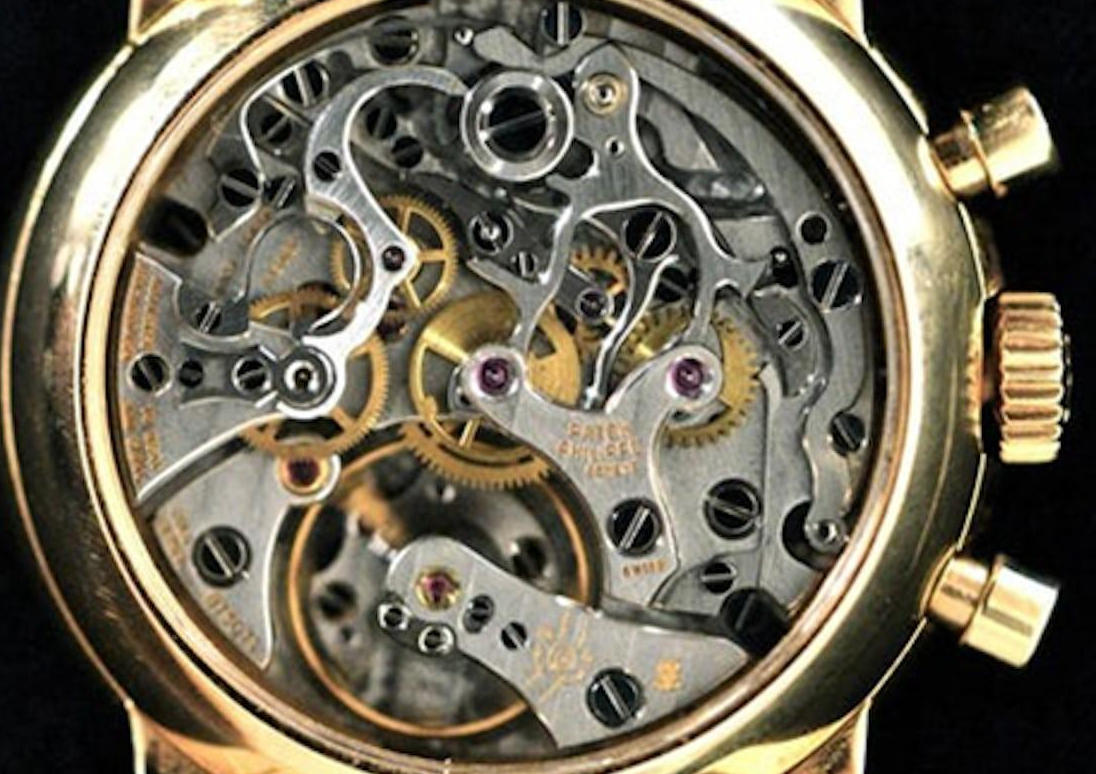
Inside the Sotheby’s example is the manually wound Calibre 27-70 Q, with 24 jewels and movement number 875,000. The movement is based on the Lemania 2310 architecture, but Patek Philippe extensively modified and finished it for its own perpetual calendar chronograph. It replaced the Valjoux-based movement used in the preceding generation and became a defining part of the 3970’s technical identity.
The movement number is particularly important in this case. Sotheby’s identifies 875,000 as the first numbered example of the 3970, which explains why the watch is referred to as The First 3970. It is more accurate to understand this as the first numbered example rather than assume that the available documentation establishes the precise moment the first physical watch was assembled. That distinction matters when discussing historically important watches, where serial records and production chronology should not be treated as interchangeable.
The case carries another identifying number, 2,824,130. Sotheby’s notes that the final three digits, 130, also appear inside the case, corresponding with the full number engraved on the inside of the caseback. This is a useful detail when examining the relationship between the case and its components. The watch is also accompanied by its Patek Philippe Certificate of Origin, presentation case and outer packaging, a Reference 3970 dossier and a Tortella & Sons passport. Such accompanying material adds useful documentation to the history of the individual example.
Why the First 3970 Matters to Collectors
The watch is scheduled to appear as Lot 88 in Sotheby’s Important Watches sale in Geneva on 8 November 2026. The published estimate is CHF 1 million to CHF 3 million. It has also appeared at Antiquorum in Paris in September 2005 and Hong Kong in June 2015. Its return to the auction market gives collectors another opportunity to examine an early example whose importance is closely tied to its position at the beginning of the reference’s production.
The estimate should be viewed alongside the details of the watch rather than as an isolated measure of its value. Its early production, movement number, snap-on caseback, original dial configuration and accompanying documentation all contribute to its appeal. Condition is equally relevant. On a vintage gold watch, the sharpness of the case edges, the definition of the lugs, the condition of the dial and the preservation of the original components can make a meaningful difference.
For anyone researching first series Patek Philippe 3970J yellow gold watches, this example provides a useful point of comparison. Its characteristics help explain why early production examples are treated differently from later 3970 and 3970E watches. The distinction is not simply about rarity. It is about understanding the original construction and recognising which details belong to the earliest generation.
The 3970 also deserves attention because it occupies an important position between the 2499 and 5970. It retained the traditional appearance of the earlier perpetual calendar chronographs but introduced the Lemania-based Calibre 27-70 Q and additional calendar information. When production ended in 2004, the 5970 took over, continuing the same broad tradition with a larger case and a new interpretation of the familiar design.
For readers exploring Patek Philippe replica watch research in the UK, the original 3970 provides a useful reference for understanding how complicated watches are constructed and why small design details matter. A replica interpretation may reproduce the general case shape, dial arrangement and appearance of the hands, but that does not mean it contains the same movement or offers the same mechanical functions as the original.
When examining a Patek Philippe 3970 replica watch design, the most revealing details are often the proportions of the case, the spacing of the subsidiary registers, the shape of the leaf hands and the position of the calendar indications. The first-series snap-on caseback is another important feature to understand when distinguishing this early design from later versions. These are more meaningful points of comparison than broad marketing descriptions that promise an identical watch without explaining its construction.
What makes The First 3970 particularly interesting is the way it preserves the beginning of a reference that remained in production for almost two decades. Its importance is found in the relationship between its movement number, case construction, dial details and documented history. It is a reminder that the value of a complicated watch is not always found in the number of functions displayed on its dial, but in the engineering and decisions that made those functions possible.
For Patek Philippe enthusiasts, the upcoming Geneva sale is therefore about more than another expensive vintage chronograph changing hands. It brings attention back to the early years of the 3970 and the technical transition that helped define the modern generation of perpetual calendar chronographs. Nearly forty years after its introduction, the reference still offers plenty to examine, particularly when an example from the very beginning of its production comes back into view.